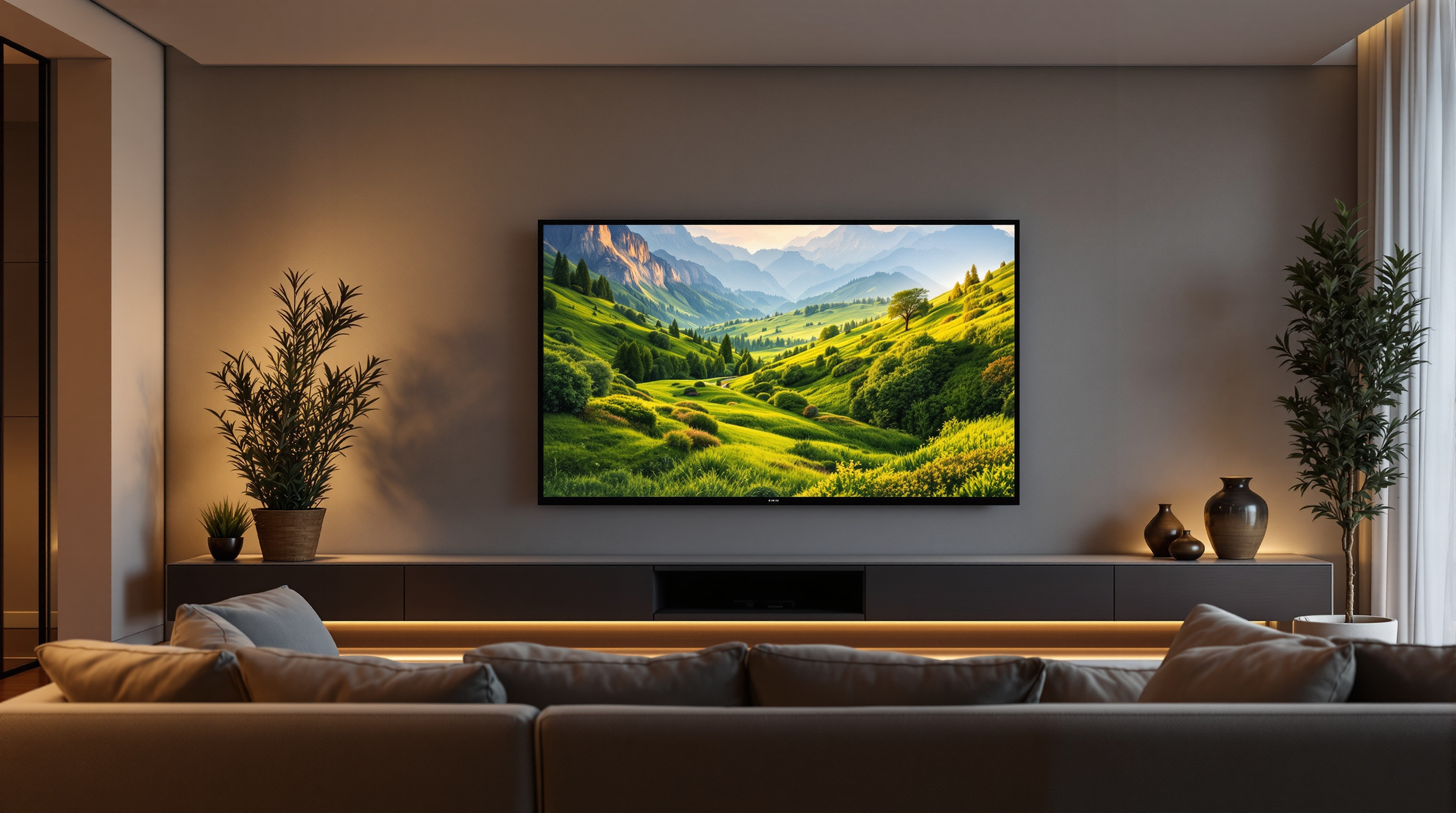
Buying a television used to be straightforward: you picked a size, checked whether it received color channels, and chose a brand you recognized. Today the decision involves panel technology, resolution tiers, HDR formats, refresh rates, smart platform ecosystems, and a persistent stream of marketing terminology engineered to obscure more than it reveals. Getting to an honest answer requires cutting through that layer.
This section covers television technology without the marketing spin — what specifications actually matter for picture quality, how different panel types compare, how to match a television to your room and viewing habits, and what to ignore on a spec sheet.
Articles in This Section
-
Understanding HDTV: A Plain-Language Guide
HD resolution explained — what the specs mean and what actually matters for your viewing experience, from 1080p through 4K and 8K.
-
Choosing a Flat Panel TV: The Complete Buyer's Guide
OLED vs. QLED vs. IPS LCD vs. VA LCD — an honest comparison of panel technologies, contrast ratios, and which type suits different rooms and use cases.
-
How to Choose the Right TV Screen Size
The right size depends on your viewing distance, not the largest available wall space. This guide explains the math and room considerations.
A Brief History of Television Technology
Understanding where television technology came from helps make sense of the current landscape and the marketing terminology that references it.
CRT (cathode ray tube) televisions dominated from the 1930s through the early 2000s. They used an electron gun to paint images line by line across a phosphor-coated screen. CRTs were heavy, deep, and limited in practical screen size, but produced genuinely excellent picture quality for their era — particularly in response time and black level. Many display enthusiasts still prefer CRTs for retro gaming for precisely these reasons.
Plasma displays emerged as the first viable large flat-panel alternative in the late 1990s and dominated the premium market through the mid-2000s. Plasma worked by exciting gas cells to produce light, with each cell functioning as its own light source — a property that gave plasma sets excellent contrast, deep blacks, and wide viewing angles. Plasma was discontinued by major manufacturers around 2014, largely due to power consumption and manufacturing cost disadvantages compared to LCD, despite many enthusiasts considering late-era plasma sets the best picture quality of any flat panel technology until OLED's maturation.
LCD (liquid crystal display) technology, which uses a backlight behind liquid crystal cells that block or pass light to create an image, became dominant after plasma's exit and remains the dominant panel technology by volume today. LCD is manufactured at lower cost than OLED and can achieve very high peak brightness, making it effective in well-lit rooms. Its weakness is that the backlight bleeds through even when a pixel is supposed to be black, limiting contrast ratio compared to self-emissive technologies.
OLED (organic light-emitting diode) panels, which became commercially available in large screen sizes around 2013 and have dropped significantly in price since, are self-emissive — each pixel generates its own light and can be individually switched off for a true black. This gives OLED essentially infinite contrast ratios and eliminates backlight bleed. OLED sets are the current gold standard for picture quality in controlled lighting.
What to Focus on When Buying
Resolution
Resolution refers to the number of pixels: 1080p (1920×1080) was the HD standard for many years; 4K UHD (3840×2160) is the current mainstream standard for sets sold today; 8K (7680×4320) exists at the high end but has negligible content at time of writing. For most viewing distances and screen sizes, 4K provides the detail benefit over 1080p. The 8K premium is difficult to justify given the absence of 8K streaming or broadcast content.
Panel Type and Contrast
After resolution, panel type is the most consequential specification for picture quality. An OLED's ability to display true black fundamentally changes the quality of dark scene rendering compared to even the best LCD. For bright-room viewing, QLED and other high-brightness LCD technologies outperform OLED in perceived contrast under ambient light. The right choice depends on your room.
HDR (High Dynamic Range)
HDR formats — HDR10, HDR10+, and Dolby Vision — expand the range between the darkest and brightest parts of an image. The benefit is most visible on compatible content. HDR10 is the universal baseline; Dolby Vision and HDR10+ add dynamic metadata that adjusts per scene. The HDR performance of a display depends as much on its peak brightness and black level capabilities as on the HDR format it supports.
Refresh Rate
Refresh rate is measured in Hz (cycles per second). Most broadcast content and streaming runs at 24, 30, or 60 frames per second. A 60Hz panel handles this without any processing required. 120Hz panels can display content at up to 120 frames per second — beneficial for gaming and sports — and also provide a higher-quality base for motion interpolation processing if you choose to enable it.
Smart TV Features
Virtually all televisions sold today include a smart TV platform — a built-in operating system that provides access to streaming applications (Netflix, Prime Video, Disney+, YouTube, and others) without any external device. The major smart TV platforms include Google TV (used by Sony, TCL, and others), webOS (LG), Tizen (Samsung), and Roku TV.
Smart TV platforms vary in quality. Some are fast, well-organized, and receive long-term software updates; others are slow, cluttered with promoted content, and receive only brief support windows before being abandoned. One practical consideration: an external streaming device (Roku, Fire TV Stick, Apple TV, Chromecast with Google TV) typically provides a faster and more consistently updated interface than a built-in smart TV platform, and can be replaced independently when it ages.
For objective, measurement-based TV comparisons across all major brands, RTINGS.com provides the most rigorous independent testing available to consumers. For regulatory context and consumer protection basics, the FCC consumer TV guides cover broadcast, cable and satellite television.
If you're building a complete home entertainment setup, our speaker buying guide covers how to add quality audio to any viewing environment.