Speaker specifications are some of the most abused numbers in consumer electronics. Power handling ratings are inflated by using non-standard measurement conditions; frequency response is reported at tolerances that allow essentially any speaker to claim "20Hz–20kHz"; efficiency ratings are measured inconsistently. Shopping for speakers by spec sheet alone, without understanding what the numbers mean and how they're measured, produces poor results.
This guide explains which speaker specifications actually predict performance, how to read them correctly, and what other factors — notably the room — matter as much or more than any single specification.
Sensitivity: The Most Important Spec
Sensitivity measures how efficiently a speaker converts electrical power into sound. It's typically expressed as dB SPL at 1 meter with 1 watt of input (dB/1W/1m). A speaker rated at 90dB sensitivity is 3dB louder than one rated at 87dB for the same input power. Since 3dB represents approximately a doubling of perceived volume, this difference is substantial — particularly relevant when matching speakers to an amplifier.
Why does sensitivity matter so much? Because amplifier power is often oversold, and efficient speakers make quiet amplifiers sound entirely adequate. A speaker rated at 88dB sensitivity pairs well with a 50-watt amplifier for normal listening levels in a typical room. A speaker rated at 82dB sensitivity might need 200+ watts to achieve the same volume levels, completely changing the amplifier requirements and system cost.
High-sensitivity speakers (90dB and above) are associated with horn-loaded designs — common in Klipsch's lineup — and are particularly sought after for use with low-powered amplifiers, including tube amplifiers. Lower sensitivity speakers (83–87dB) typically require more powerful amplifiers but are not inherently better or worse sounding; sensitivity is a design trade-off, not a quality indicator.
Impedance: Matching Speakers to Amplifiers
Impedance is the electrical resistance that the speaker presents to the amplifier, measured in ohms (Ω). Most consumer speakers are rated at 8Ω nominal, though many dip lower at specific frequencies. Some speakers are rated at 4Ω, which draws more current from the amplifier for the same voltage output.
The practical importance of impedance is in amplifier matching. Most stereo receivers and integrated amplifiers are designed for 8Ω loads. A 4Ω speaker can be used with most amplifiers, but will draw more power and generate more heat, and may exceed the amplifier's current delivery capability at high volumes — causing distortion or, in extreme cases, triggering protection circuitry or causing damage. Check that your amplifier specifies compatibility with 4Ω loads before pairing it with 4Ω speakers.
The published nominal impedance is a simplified average across frequencies. Real speaker impedance varies significantly with frequency — a speaker nominally rated at 8Ω may dip to 3Ω at specific bass frequencies. This is why high-quality amplifier measurements include data on how the amp behaves into reactive (varying impedance) loads.
Frequency Response: What It Actually Tells You
Frequency response describes how evenly a speaker reproduces sound across the audible frequency range (typically 20Hz to 20,000Hz for humans with normal hearing). A flat frequency response means the speaker reproduces all frequencies at equal volume; deviations from flat mean some frequencies are boosted or reduced relative to others.
The critical missing information in most published frequency response specifications is the tolerance. "20Hz–20kHz" is meaningless without a ±dB figure: a speaker rated 20Hz–20kHz ±3dB is flat; a speaker rated 20Hz–20kHz with an unspecified tolerance might have 20dB swings across that range. Most budget and mid-range speakers that claim 20Hz low frequency extension are reporting the frequency at which output exists, not the frequency at which it's at a useful level.
A realistic frequency response for a quality 6-inch bookshelf speaker is approximately 55–20,000Hz ±3dB — meaning bass extension begins meaningfully around 55–60Hz, and everything from there up to 20kHz is reproduced within 3dB of flat. Adding a subwoofer fills the 20–55Hz range that the bookshelf speaker can't reproduce at useful volume levels. Claiming 35Hz extension for such a speaker is technically achievable but misleading if the output at 35Hz is 15dB below midrange levels.
Driver Types and Construction
Speaker drivers are the individual transducers inside the cabinet that convert electrical signal to physical movement. Most speakers use multiple drivers covering different frequency ranges:
Woofer: The largest driver in the cabinet, responsible for bass frequencies. Typically made from paper, polypropylene, or metal (aluminum, magnesium). Larger diameter woofers can move more air, which is the fundamental requirement for bass reproduction. A 6.5-inch woofer goes significantly lower with more authority than a 4-inch woofer.
Tweeter: The small driver responsible for high-frequency (treble) reproduction. Dome tweeters are most common, typically made from fabric (soft dome) or metal (hard dome). Soft dome tweeters tend toward a warmer, smoother sound; metal dome tweeters can sound more detailed but sometimes overly bright depending on implementation. Ribbon tweeters, used in higher-end designs, can achieve very high frequency extension and low distortion but are more expensive to produce.
Midrange driver: Used in three-way or four-way speaker designs to handle frequencies between the woofer and tweeter crossover points. By dedicated a separate driver to midrange reproduction, each driver can be optimized for its own frequency range without the compromises inherent in a two-way design handling a broader bandwidth.
The crossover network is the passive circuit inside the speaker that routes different frequency bands to the appropriate driver. A well-designed crossover is as important as the drivers themselves — poor crossover design creates phase problems and frequency response irregularities at the crossover points that are difficult to hear in isolation but contribute to listener fatigue over extended listening sessions.
Bookshelf vs. Floor-Standing vs. Soundbar
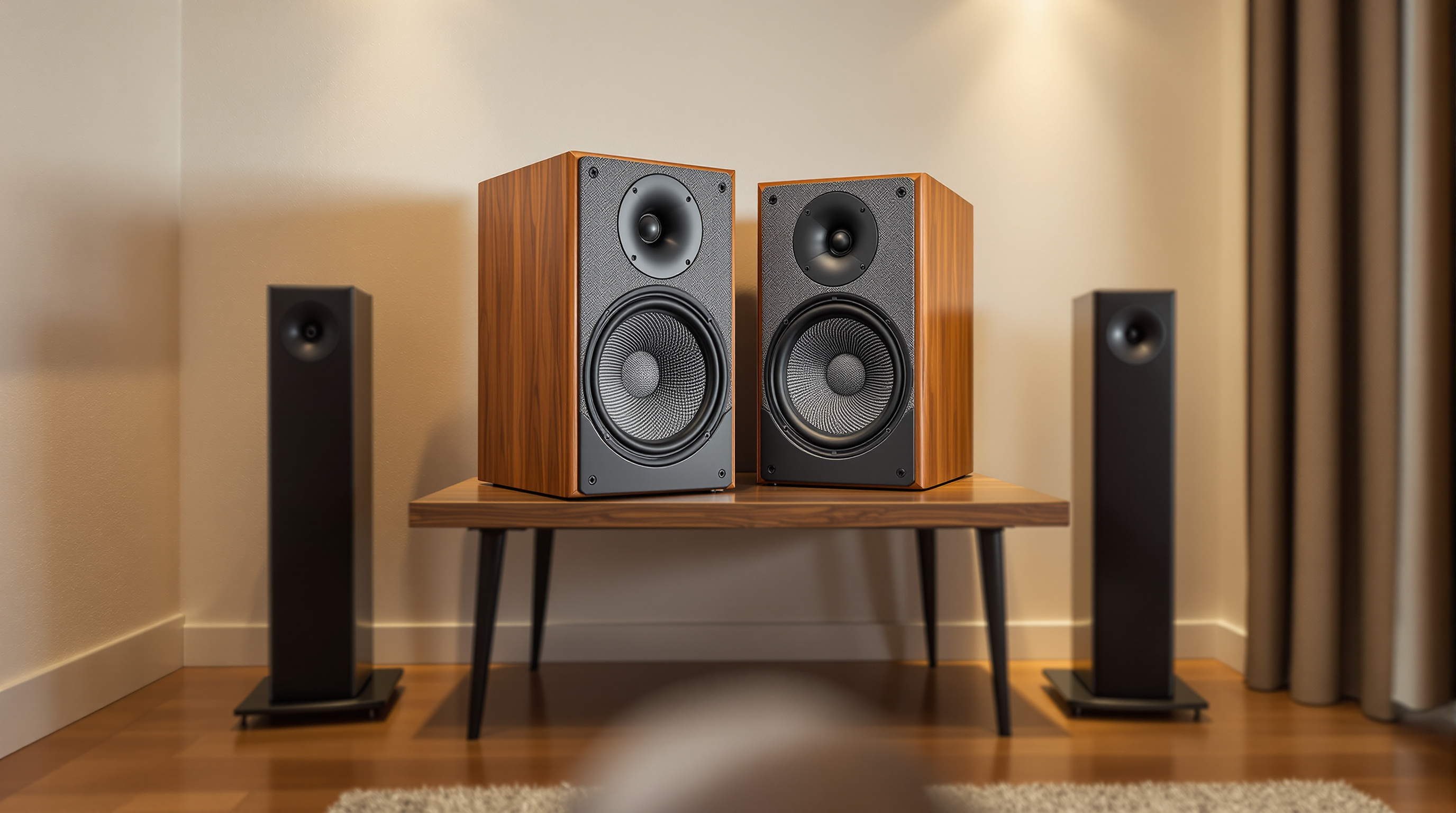
Bookshelf speakers (compact two-way designs typically in the 5–7 inch woofer range) are the most versatile form factor: they work on stands, on shelves, and on desktops, they pair with subwoofers naturally, and they represent the best performance-per-dollar in the speaker market because the engineering is well-understood and the form factor is broadly supported. Their limitation is bass extension — most bookshelf speakers roll off meaningfully below 60–80Hz and need a subwoofer for full-range reproduction.
Floor-standing speakers (tower speakers) contain larger and often multiple woofer drivers, enabling meaningful bass extension down to 40–50Hz without a subwoofer. They're physically larger and more expensive, but for listeners who prefer not to add a subwoofer, they offer a more complete frequency range in a single cabinet. The tradeoff is room interaction: large floor-standers in small rooms can create bass-heavy presentations that are difficult to correct with placement alone.
Soundbars are a pragmatic solution for television audio — they dramatically improve on the thin, directionally challenged sound of built-in TV speakers without the complexity or footprint of a component system. Premium soundbars with Dolby Atmos object-based audio processing provide a reasonable approximation of surround sound from a single horizontal bar. The limitation is physics: a soundbar's small drivers in a narrow cabinet cannot replicate the spatial precision, dynamic range, or bass extension of a component speaker system with a subwoofer. Soundbars are excellent for their intended purpose; they're not a substitute for a stereo or surround speaker system for critical listening.
Active vs. Passive Speakers
Passive speakers contain only drivers and a crossover network. They require an external amplifier — a stereo receiver or integrated amplifier — to drive them. This means more boxes and cables, but also the freedom to upgrade each component independently. The quality of passive speakers at a given price point is generally higher than powered speakers at the same price, because none of the budget is spent on the built-in amplifier electronics.
Active (powered) speakers have the amplifier circuits built into the speaker cabinet. This simplifies setup considerably — you plug in a source (phone, computer, streaming device) and the system is operational without a separate amplifier. Many excellent active speakers use class D amplifiers with DSP (digital signal processing) correction to compensate for their own frequency response irregularities and room placement — something passive speakers cannot do without external room correction. For desktop systems, studio monitors, and spaces where a separate amplifier is inconvenient, active speakers are an excellent choice.
Cross-Checking the Spec Sheet
Because manufacturers measure and report speaker specifications so inconsistently, the published numbers are a starting point, not a verdict. The most reliable way to compare two speakers is to set the marketing copy aside and look at standardized third-party measurements taken under controlled conditions. Independent test labs measure on-axis and off-axis frequency response, distortion at defined output levels, and impedance curves across the full frequency range — data that reveals the compromises a spec sheet conceals. A speaker that claims "20Hz–20kHz" tells you almost nothing; the same speaker's measured response, plotted with a stated tolerance in an anechoic chamber, tells you almost everything. When two products list identical specifications at very different prices, independent measurement is usually what explains the gap. Treat any performance number without a documented measurement methodology as an advertising claim rather than an engineering fact, and weight your decision toward the sources that publish their methods. That is the difference between shopping by brochure and shopping by evidence.
The same discipline applies to what a pair of speakers costs. Speaker pricing is unusually elastic: models are discounted heavily at the end of a product cycle, refurbished stock from the manufacturer often carries the full warranty at a substantial reduction, and the open-box unit on the shelf is frequently a returned pair that was auditioned once. None of that changes the measurements, which is precisely the point — once you have identified a model on the evidence, the remaining question is timing rather than judgement. Note the model, watch it for a few weeks, and buy when the price is right rather than when the marketing calendar says so.
How to Audition Speakers
If possible, audition speakers before buying. The specifications don't capture everything that matters for listening comfort over time. When auditioning:
- Use familiar music — material you know well, across genres (orchestral, vocal, acoustic, bass-heavy). You'll notice deviations from what you expect much more reliably with familiar material.
- Listen for harshness — particularly in the upper midrange and lower treble (2–5kHz). Brightness can initially sound like "detail" but becomes fatiguing over long listening sessions.
- Listen for bass character — accurate, tight bass vs. boomy, slow bass. Speakers that overemphasize bass frequencies below their natural extension sound impressive initially but become inaccurate and tiring.
- Match volume levels when comparing. A louder speaker always sounds "better" on casual comparison — if one pair is noticeably louder than the other, the sensitivity difference is confounding the comparison. Adjust volume controls to equalize perceived loudness before evaluating sound quality.
For measured frequency response, distortion, and directivity data on specific speaker models, Audio Science Review publishes rigorous, standardized measurements. Stereophile publishes both measurements and listening reviews for a broad range of loudspeakers, including their own standardized in-room response measurements.
For headphone listening rather than speaker systems, see our guide to choosing headphones. For an overview of how speakers fit into a complete home audio system, see the stereo and audio equipment overview.