A coin found in an attic, dug from a garden, or pulled from a roll of bank change carries its history on its surface — accumulated toning, light wear, the patina of decades. The instinct, especially for newcomers to collecting, is to polish this away and restore what looks like new condition. This is almost always a mistake. Professional graders can detect cleaning through a loupe in seconds, and a cleaned coin — regardless of its age or rarity — is permanently damaged in the eyes of the numismatic market. Understanding why requires understanding what a coin's surface actually is.
What Coin Surfaces Actually Are
When a coin is struck, the metal flows under enormous pressure from the dies into every detail of the design. The surface that results — called the field (the flat areas) and the devices (the raised design elements) — has a specific microscopic texture determined by the die surface and the striking force. On uncirculated coins, this texture creates cartwheel luster: the way light reflects across the coin's surface in a sweeping pattern as you rotate it. This luster is fragile. It exists in the microscopic flow lines of the metal's surface. Any abrasion — including polishing with a soft cloth — disrupts these flow lines and replaces them with circular scratches (hairlines) that graders identify immediately. Once luster is gone, it cannot be restored.
Understanding this distinction — between original surface texture and the appearance of that texture — is the key insight in numismatic preservation. The coin's grade, and therefore its market value, depends entirely on how well the original surface survives. A coin that looks duller but retains its original luster will always grade higher and sell for more than a coin that looks brighter but has been polished.
The Science of Toning
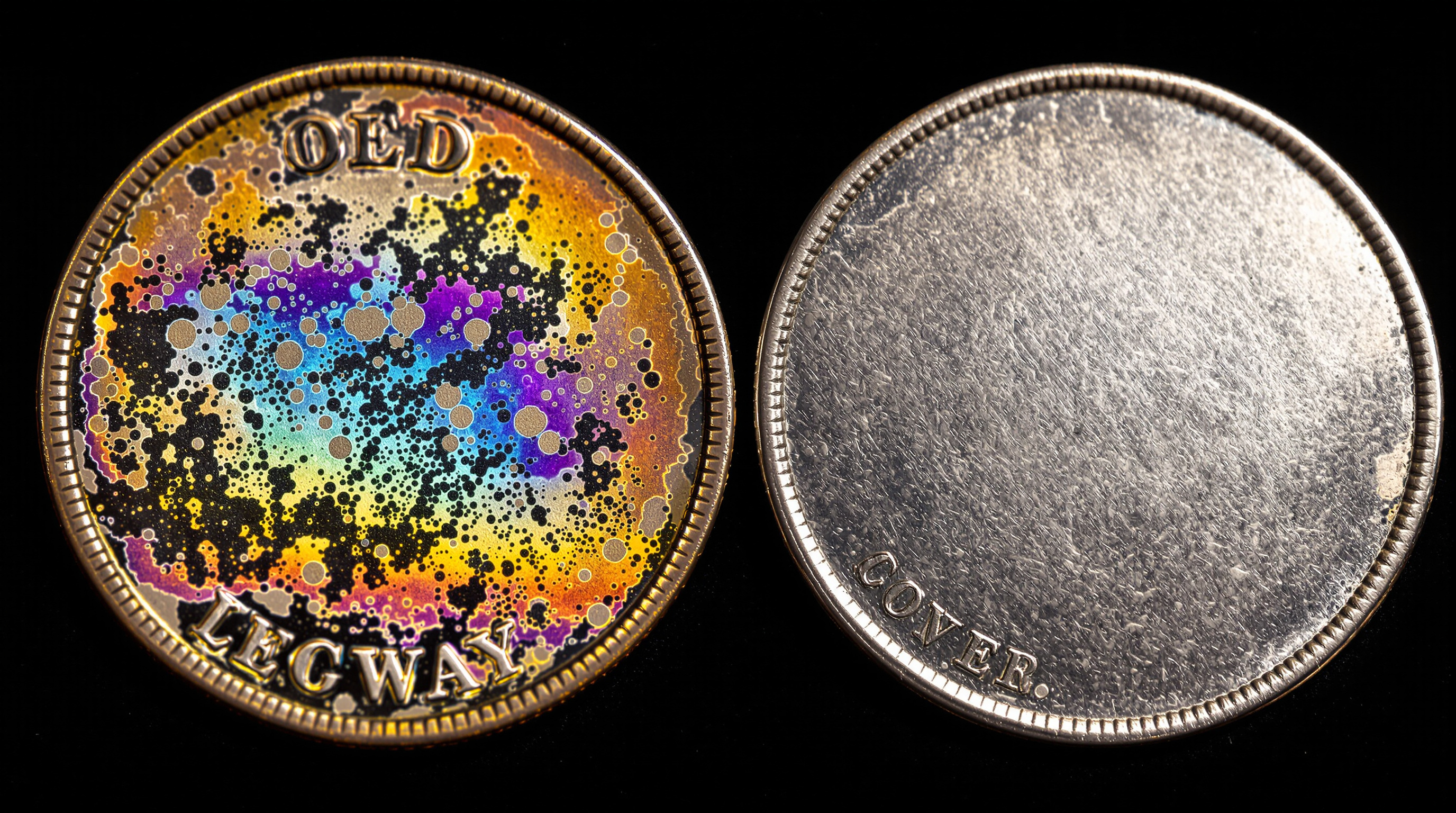
Natural toning is not dirt. It is the result of chemical reactions between the coin's metal and atmospheric compounds over time. Silver reacts with hydrogen sulfide (present in the atmosphere, in paper, in rubber bands, and in certain woods) to form silver sulfide — the brown-to-black compound that creates toning on silver coins. Copper reacts with oxygen and various acids to create the spectrum of colors seen on copper cents, from light brown through chocolate to steel and blue-green. The rate and pattern of toning depends on storage environment, coin composition, and time. Attractive, even toning is considered desirable by many collectors — it is evidence of original, undisturbed surfaces. Rainbow toning on silver Morgan dollars, for example, regularly commands significant premiums at major auction houses.
The distinction that matters is between toning and environmental damage. Toning that developed gradually and evenly across a coin's surface represents its natural aging. Corrosion — spotty, pitted, or lifting — represents damage from hostile environments: high humidity, acidic materials, or active chemical contact. Toning is desirable and should be preserved. Corrosion is damaging, may require professional conservation, and is a separate issue from cleaning. Many new collectors confuse the two and attempt to remove desirable toning while thinking they are improving the coin.
What Cleaning Does Under a Microscope
The mechanism of cleaning damage depends on the cleaning method, but all methods share the same outcome: they alter the original surface in ways that are detectable under magnification.
Polishing with a soft cloth — even a jeweler's cloth — creates parallel or circular hairlines across the coin's fields. Under 10x magnification, these hairlines catch light and scatter it in a pattern distinct from wear or original luster. The fields of a polished coin show a fine web of scratches that betray the cleaning immediately to any experienced grader.
Dipping in chemical silver cleaner (thiourea-based solutions) strips the sulfide layer that creates toning. The result is a coin with unusual brightness and a slightly muted or "washed out" luster that experienced graders immediately recognize as dipped. Repeated dipping thins the metal and eventually creates a lifeless, flat appearance. A single careful dip by an experienced conservator is sometimes accepted by grading services on certain coins, but this is a narrow exception requiring professional judgment — not a technique for beginners.
Ultrasonic cleaners agitate the surface with millions of tiny bubbles, effectively sandblasting the coin at a micro scale. The damage is severe and irreversible. Despite being marketed for jewelry and coin cleaning, ultrasonic cleaners are destructive to original coin surfaces and should never be used on collectible coins.
Abrasive products — metal polishes, baking soda pastes, toothpaste — remove metal from the coin's surface along with any toning or surface contamination. The damage from abrasive cleaning is typically the most severe and the most obvious under grading conditions.
How Graders Detect Cleaning
Professional coin graders at PCGS and NGC examine every coin under directional light and magnification before certifying. Cleaned coins are designated "details" grades — for example, "AU-55 Details, Cleaned" — which indicates the coin would have graded AU-55 based on wear, but its surfaces have been altered. Details-graded coins sell at steep discounts compared to problem-free examples of the same grade. A Morgan dollar worth $200 in AU-55 might sell for $40–60 as a details coin. The cleaning does not need to be severe to trigger a details designation — light hairlines from a single polish are sufficient.
The grading process uses directional lighting — typically a single high-intensity lamp positioned to rake across the coin's surface — that reveals hairlines invisible under ambient light. Graders rotate coins slowly under this light, watching for the characteristic scatter pattern of cleaning hairlines versus the flowing reflections of original luster. This technique is also how collectors should examine coins they are considering buying, and it is why the standard advice is to examine coins under a single bright light source rather than overhead fluorescent or LED panels.
Details designations are permanent in the grading services' databases. A cleaned coin certified in a PCGS or NGC "details" holder cannot be resubmitted for an upgrade — the surfaces are what they are. This is why prevention matters so much: there is no way to reverse cleaning damage and restore original surfaces.
Proper Coin Handling
Prevention is the foundation of coin preservation. Never touch the face (obverse) or reverse of a coin with bare fingers. Fingerprints contain oils and acids that etch the surface within hours on high-grade coins and leave permanent prints on silver. Hold coins by the edge only, with fingers on the rim. When examining a coin, work over a soft surface (a coin examination pad or folded cloth) to catch drops. Use cotton gloves for valuable pieces, or practice handling by edges until it becomes habit.
Examine coins under good directional light — either a single halogen bulb or sunlight — while slowly rotating the coin to observe luster and surface quality. A bright LED flashlight held at a shallow angle to the coin's surface is effective for field examination. The goal is to see the cartwheel luster rotating across the coin's surface; if the luster breaks up into scattered reflections rather than flowing across the coin, something has disrupted the surface texture.
Store coins in inert materials. Mylar flips (2x2 polyester holders) are the standard for individual coins — they are chemically inert and do not off-gas compounds that react with coin surfaces. Avoid PVC-containing soft plastic flips, which are common and appear similar to Mylar but leach plasticizers that cause green slime and permanent damage to coin surfaces over time. Cardboard 2x2 holders with Mylar windows are another safe option for long-term storage. Hard plastic slabs from grading services (PCGS, NGC) provide the best protection for valuable coins.
Safe Conservation vs. Cleaning
Conservation is different from cleaning. Conservation removes active damage that threatens the coin's metal — verdigris (green copper corrosion) on bronze coins, for example, is actively eating into the coin's surface and removing it stops ongoing damage. Conservation does not attempt to improve the coin's appearance or remove toning; it stabilizes the coin's condition by halting destructive chemical processes.
Professional conservation is available through services affiliated with major grading companies. For valuable coins with active corrosion or environmental damage, professional conservation before submission to PCGS or NGC is often worth the cost. The conservator removes the active corrosive agent without disturbing surrounding original surfaces, and the resulting coin may grade as problem-free if the conservation was successful and the underlying surface is intact.
Do-it-yourself attempts at conservation using household chemicals on valuable coins are not recommended — the risk of additional damage significantly outweighs the potential benefit. Acetone (pure, not nail polish remover which contains additives) is accepted for removing certain surface contaminants from copper coins without harming the metal, but this narrow application requires research and a careful hand. Beyond acetone on copper, home conservation attempts generally cause more damage than the original problem.
What to Do Instead of Cleaning
If you find a coin you suspect is valuable, resist any cleaning impulse and follow these steps: store it in an inert Mylar flip, never a PVC-containing flip; handle it by the edges only; photograph it before storing; research the date and mintmark to determine if professional grading is warranted. Resources like Numismatic News provide current market values and collector guidance that can help you determine whether a coin is worth the cost of professional grading (typically $20–50 per coin at major services).
For a coin you found metal detecting, rinse with distilled water only to remove loose soil — let it air-dry face-up without touching, then store. Distilled water does not harm original surfaces. Everything beyond distilled water is cleaning, and cleaning is permanent.
If you have already cleaned a coin, the damage is done — but the coin is still worth preserving. Store it properly, document its condition honestly, and consider it a tuition payment on a lesson that most collectors learn only once. A details-graded coin still carries historical interest and can still be enjoyed as part of a collection, even if its market value is diminished. The goal going forward is not to compound the damage.
For further context on grading standards and how numerical grades map to coin condition, the PCGS grading standards guide is the most thorough freely available reference, covering every series with photo examples at each grade level. Understanding the Sheldon scale and the specific surface attributes graders evaluate will make it much clearer why cleaning — even light cleaning — is so consequential to a coin's grade and value.
See also our guides to mint errors and the State Quarters program for more numismatic reference material, or return to the coin collecting overview for the full section index.